Brand TLD adoption is no longer just a futuristic concept; it is becoming a critical differentiator for global market leaders. If your company is still relying solely on legacy domain extensions like .com or .net, you are essentially renting land in a crowded digital city.
As the internet evolves, forward-thinking organizations are seizing the opportunity to apply for their own Top-Level Domains (TLDs). But why is this shift happening now?
In this post, we will explore the three transformative benefits of operating a proprietary brand TLD, based on the latest insights from the TLDTR ecosystem.
1. Brand TLD Ownership: Become a Digital Property Owner
Most companies do not realize that their current domain strategy is built on a “tenancy” model. When you register a standard domain, you are subject to the rules, pricing models, and availability constraints of a public registry.
Moving to a brand TLD transforms you from a tenant into a landlord. This is a fundamental shift in digital equity.
- Asset Valuation: A proprietary extension (e.g.,
.appleor.bmw) is an intangible asset that sits on your balance sheet. It is digital real estate that you own outright. - Global Prestige: Utilizing a brand TLD signals to the market that your organization has reached a level of maturity and scale that warrants its own piece of the internet infrastructure.
By securing your own registry, you aren’t just registering a name; you are solidifying your digital sovereignty for decades to come.
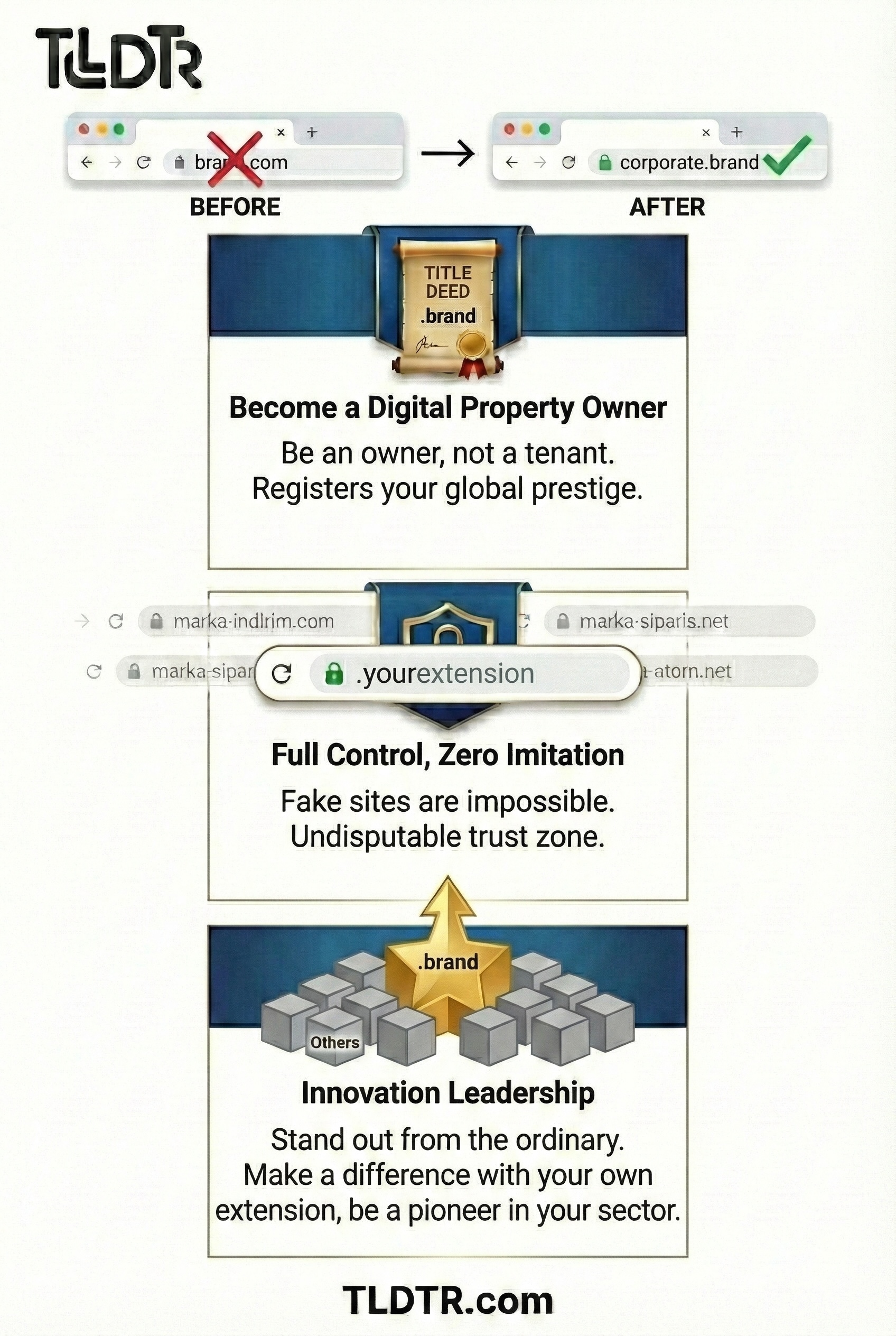
2. Unmatched Security: The “Brand TLD” Trust Zone
Security is perhaps the most compelling argument for this transition. In an era where phishing, domain spoofing, and “typosquatting” cost businesses millions annually, a brand TLD offers a fortress-like solution.
On the open web, anyone can register yourbrand-login.com to trick your customers. However, a .brand registry is a “closed garden.”
- Exclusive Rights: Only your organization can assign domain names ending in your extension.
- Zero Imitation: If a customer sees a URL like
support.yourbrandorpay.yourbrand, they know with 100% certainty that it is authentic. It creates an undisputable trust zone that fraudsters technically cannot breach.
For financial institutions, healthcare providers, and e-commerce giants, a brand TLD is not just a marketing tool—it is a cybersecurity necessity.
3. Innovation Leadership with a Brand TLD Strategy
Finally, standing out in a saturated market requires bold innovation. Legacy URLs are often long, clunky, and forgettable. A brand TLD allows you to streamline your user experience and position your company as a sector pioneer.
Consider the marketing potential of replacing brand-investor-relations.com with a sleek, memorable investors.brand.
- Memorable Campaigns: You can create intuitive domains for specific products or campaigns on the fly (e.g.,
blackfriday.brandorsummer.brand). - Modern Identity: Adopting this technology positions your company as a leader in digital transformation, separating you from competitors who are stuck in the “dot-com” era.
How to Secure Your Brand TLD
Applying for a new gTLD (generic Top-Level Domain) is a complex process governed by ICANN (Internet Corporation for Assigned Names and Numbers). It requires technical expertise, legal preparation, and strategic planning.
The window for these applications is rare. Missing the opportunity means waiting years for the next round, while your competitors potentially secure their own namespaces.
Conclusion
The transition from a rented address to a branded digital ecosystem offers security, prestige, and control that legacy domains simply cannot match. A brand TLD is more than a URL; it is the future of your corporate identity.
Are you ready to stop renting and start owning? With the next round of applications commencing in April 2026, time is of the essence. Successful applicants are already preparing; now is the moment to refine your brand TLD strategy and secure your digital roadmap.
Contact TLDTR today to consult on your Brand TLD application strategy