In the modern digital ecosystem, the concept of brand TLD security is shifting from a niche internet governance topic to a critical boardroom imperative.
As phishing and fraud statistics continue to spike globally, it has become clear that traditional defense mechanisms are failing. The current industry standard, chasing down fraudulent sites one by one, often referred to as the “Whac-A-Mole” approach is exhausting, expensive, and ultimately ineffective against the sheer volume of automated attacks.
The solution lies in a fundamental architectural shift: moving from open, public domains (like .com or .net) to closed, proprietary Brand TLDs (Top-Level Domains).
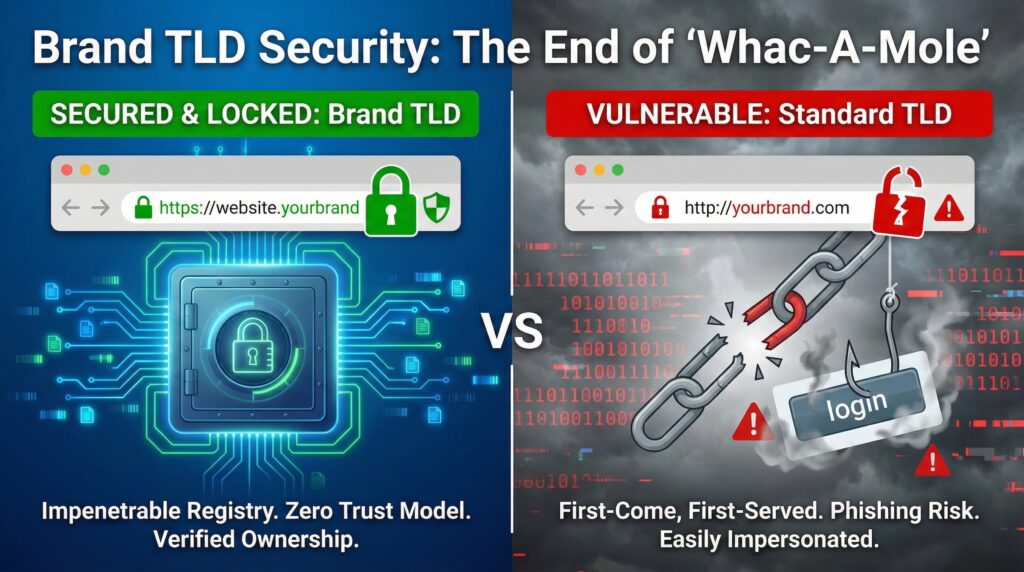
The “Open Garden” Vulnerability
To understand why brand TLD security is revolutionizing digital trust, we must first address the inherent flaw in the current system.
In the traditional domain world, the registration model is “First Come, First Served”. While this democratizes the internet, it creates a massive attack surface for criminals to exploit through:
- Cousin Domains: Attackers register slightly altered versions of a legitimate domain (e.g.,
bank-login.cominstead ofbank.com) to deceive users. - Visual Cloning: Fraudsters copy a site’s HTML and CSS entirely, making the fake site visually indistinguishable from the real one.
- SEO Poisoning: Hackers manipulate search engine results to place fraudulent sites above legitimate ones for high-traffic keywords, directing users to compromised pages.
In this environment, even if authorities block thousands of malicious sites, the “open” nature of public extensions allows thousands more to appear instantly.
How Brand TLD Security Changes the Game
A Brand TLD (e.g., .brand, .bank, .group) transforms a company’s digital presence from “Public Space” to “Private Property”. This introduces a “Zero Trust” model that creates an almost impenetrable barrier against impersonation.
Here are the three pillars of brand TLD security:
1. The Closed Registry System
Unlike public extensions where anyone can register a domain, a Brand TLD acts as a Closed Registry.
- Exclusive Access: Only the brand owner can register domains with that extension.
- Impossible Impersonation: It is technically impossible for a scammer to register
campaign.yourbrand. If a user sees a URL ending in.yourbrand, they know with absolute certainty it belongs to you. - Visual Trust: Security becomes visible. Brands can educate consumers to “Look at the extension” as the ultimate proof of legitimacy.
2. “God Mode” Management vs. Legal Delays
One of the most powerful aspects of brand TLD security is the shift from reactive legal processes to proactive technical control.
- The Old Way: Removing a phishing site on a public domain often requires court orders, notary approvals, and international arbitration, processes that can take days or even years.
- The Brand TLD Way: Because the brand owns the registry, they possess “Registry Operator Rights”. If a subdomain is compromised or a malicious insider creates a rogue page, the IT team can issue a “Server Hold” command directly.
- Result: The threat is neutralized globally in seconds, without a single lawyer involved.
3. Unbreakable Email Authentication
Phishing isn’t just about websites; it is often delivered via email. Brand TLDs mandate high security protocols by default.
- Strict Policies: ICANN requires new gTLDs to support DNSSEC. Furthermore, brands can enforce DMARC policies at the strictest level (
p=reject) across the entire extension. - No More Spoofing: An email appearing to come from
support@yourbrandwill be automatically blocked by receiving servers if it didn’t originate from your authorized infrastructure, effectively cutting off email-based fraud.
The Strategic Role of Infrastructure Partners
Implementing brand TLD security requires robust infrastructure. Brands must collaborate with specialized Registry Service Providers (RSPs) and ICANN to navigate this transition.
- Registry Service Providers (RSPs): These partners provide the “backend registry” infrastructure. Instead of building a data center to manage the TLD, brands utilize the RSP’s ICANN-accredited ready-made infrastructure.
- Data Sovereignty: Working with the right RSP allows organizations to keep the management data of their critical internet traffic within their preferred jurisdiction, ensuring compliance with regional data privacy regulations.
Conclusion: A Necessary Evolution
The massive financial losses attributed to cyber fraud prove that cybercrime is a well-funded economy. To combat it, organizations must move beyond the “patch and pray” methods of the past.
Brand TLD security offers a path where trust is baked into the architecture of the internet itself. By adopting their own extensions, forward-thinking organizations can finally stop playing “Whac-A-Mole” with fraudsters and secure their digital borders once and for all.
Would you like me to create a checklist for your C-Suite executives to evaluate the ROI of applying for a Brand TLD in the next ICANN round?